

There is a particular kind of experimentation programme that looks perfectly healthy from a distance.
Tests are running. A dashboard exists. Results get shared in a monthly email. Someone presents a win at the quarterly review. If you glance at it, you would conclude the organisation is experimenting and learning.
Then a new CFO arrives, or a cost review lands, or a new product leader asks a simple question: “What has this changed?” And the programme cannot answer. Within two budget cycles, it is gone.
The uncomfortable truth is that the programme was not killed by the question. It was killed years earlier, when it settled into a rhythm of bare minimum activity that was calibrated to the questions nobody was asking. Coasting programmes do not fail loudly. They fail quietly, and the failure only becomes visible when scrutiny arrives.
Here are the signs to look for, long before anyone starts asking.
1. Activity is the headline
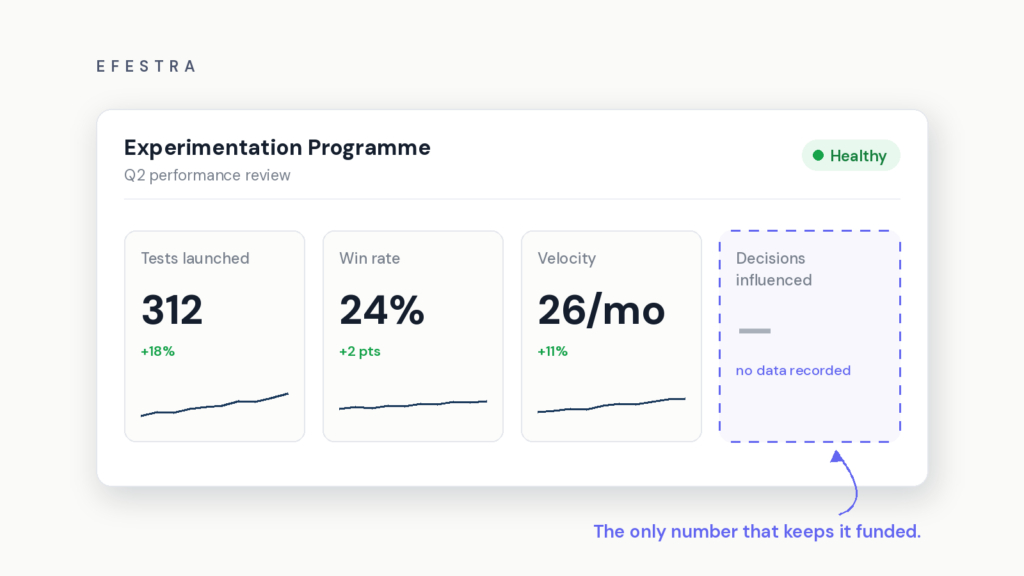
Coasting programmes report what they did. Tests launched, win rate, average lift. These numbers feel like progress, and they are easy to produce every month without changing anything about how the organisation works.
Thriving programmes report what changed. Decisions influenced, winning variants shipped, revenue recovered from a failed idea that never went live. The difference matters because activity metrics can climb indefinitely while business impact stays flat. A programme that ran 300 tests last year has told you nothing until it can tell you what those tests moved.
If your monthly report would read identically whether the business acted on your results or ignored them entirely, that is the first sign.
2. The calendar is full but the bets are small
Look at what is actually being tested. Coasting programmes fill their pipeline with safe, low-consequence changes: button copy, banner placement, minor layout variations. These tests are quick to build, unlikely to upset anyone, and keep the velocity numbers respectable.
What you will not find is anything that touches pricing, positioning, product strategy or a decision leadership actually cares about. The programme has learnt, often without anyone deciding it consciously, that small tests are the path of least resistance. High activity, low stakes, no strategic footprint.
A full calendar is not evidence of a healthy programme. It can just as easily be evidence of a programme optimising for its own continuation.
3. Wins are announced, then vanish
The win is presented. There is a round of appreciation. And then nothing. Nobody tracks whether the winning variant actually shipped, whether the lift survived contact with production, or whether the change is still live six months later.
This is where the gap between claimed value and real value opens up. Programmes routinely present cumulative “wins” worth millions in projected uplift, and almost none of it survives scrutiny because nobody followed the result past the announcement. When a finance team eventually reconciles those claims against actual revenue, the credibility damage is severe and usually terminal.
A thriving programme treats the test result as the midpoint, not the finish line. Implementation is tracked, validated and reported with the same rigour as the experiment itself.
4. Knowledge is documented but never retrieved
Most coasting programmes can point to a repository. Notion, a spreadsheet, a testing tool archive. Documentation exists, so the box appears ticked.
The test is not whether knowledge is stored. It is whether knowledge is used. Ask when a past result last changed a current plan. Ask how often teams check what was tested before proposing something new. In a coasting programme, the honest answer is rarely or never, and the giveaway is repetition: the same ideas resurface, the same tests get rerun, and nobody notices because nobody looks back.
Documentation records what someone chose to write down. A learning system changes what the organisation does next. These are not the same thing, and only one of them survives a value review.
5. No executive can name a decision it changed
This is the sharpest diagnostic of all, and you can run it in thirty seconds. Ask a senior leader to name the last significant decision that experimentation evidence changed. Not informed, not accompanied. Changed.
In a thriving programme, this question gets an immediate, specific answer, because the connection between evidence and decisions is visible and recent. In a coasting programme, the answer is a pause, then a generality about “data-driven culture.”
Programmes get funded by people who hold budgets, and those people fund things they can see influencing outcomes. A programme that executives tolerate but never consult is already on the list of things to cut. It just has not been told yet.
6. Everything depends on one person
Strip away the tooling and ask a structural question: if the programme lead left tomorrow, would the practice continue?
In coasting programmes, the answer is no. Quality standards exist because one person applies them. Prioritisation happens because one person pushes for it. Results get shared because one person writes the email. There is no framework enforcing any of it, only individual goodwill holding the whole thing together.
This is governance by hope, and it has two failure modes. The obvious one is that the person leaves. The subtler one is that the person gets busy, standards drift, and the programme degrades without anyone deciding it should. Thriving programmes build the standards into the system so that quality does not depend on who happens to be in the room.
7. Budget season requires archaeology
Watch what happens when renewal or budget review approaches. In a coasting programme, someone spends two weeks assembling a value case from scratch: hunting through old decks, reconstructing screenshots, stitching anecdotes into a narrative. The case has to be rebuilt every year because value was never captured as it happened.
A thriving programme never has this scramble, because the evidence of impact accumulates continuously. Decisions influenced are logged when they happen. Implementation outcomes are recorded when they land. When the question comes, the answer already exists.
If defending your programme feels like an annual archaeological dig, the problem is not the presentation. It is that the programme has been generating activity rather than accumulating proof.
Why coasting stays invisible
None of these signs triggers an alarm on its own, and that is precisely the danger. A coasting programme satisfies every casual observer. Tests are visibly running, reports are visibly circulating, and nobody’s day-to-day work is disrupted enough to prompt a hard question.
The bare minimum is a stable equilibrium right up until the environment changes. New leadership, a cost programme, a strategic pivot: any of these brings someone into the room whose job is to ask what things are for. And a programme built to satisfy the absence of questions cannot survive their arrival.
The way back
The encouraging part is that none of this requires more budget or more headcount. It requires redirecting the effort that already exists.
Start by changing what gets reported: lead with decisions influenced and implementations validated, and let activity metrics become footnotes. Put one genuinely strategic question into the pipeline each quarter, something a leader is actively wrestling with. Follow every win past the announcement to confirm it shipped and held. Build retrieval into intake, so that no new test is proposed without checking what came before. And write down the standards, so that quality survives the departure of whoever currently enforces it.
A programme that does these things does not need to prepare for the moment someone asks questions. It has been answering them all along.
The bottom line: activity is what a programme does. Evidence of changed decisions is why it exists. Coasting programmes accumulate the first and hope nobody asks about the second.