
Experimentation teams are not short of ideas. Whether that is ideas raised in meetings, from the wider organisation or even AI tools spitting out hundreds of different ideas for teams to test.
What they are really missing is the answer to this question: Is this idea worth testing?
And ideas in isolation, be they from a random external database or best practices, keep missing one thing: Context.
Efestra has released a new feature called Brainstorm that powers up its AI, Mosaic, to the next level.
Three questions that should sit between an idea and a test
Is there evidence behind this, or is it an opinion with a champion?
Ideas do not arrive with their provenance attached. A suggestion from a senior stakeholder and a finding from last month’s usability round look identical once they are both rows in a backlog. Seniority becomes a proxy for evidence, because nothing else is available at the moment of decision.
Does this align with an objective anyone is actually measured on?
Most backlogs contain ideas that would improve something real but improve nothing anyone is accountable for this quarter. They are not bad ideas. They are ideas whose success would go unnoticed.
Has this already been tested, and what happened?
This is the question that costs the most and gets asked the least. The answer usually exists somewhere: a slide from a departed colleague, a comment in a ticket, a spreadsheet tab nobody has opened since the reorganisation. The cost of retrieving it exceeds the cost of just running the test again, so teams run it again.
Why nobody asks them
Not because teams do not know they should. Because at the moment an idea enters a backlog, the information required to answer any of the three is scattered across systems, documents and people, some of whom have left. Answering properly would take an afternoon per idea. Nobody has an afternoon per idea.
So teams face a choice between two bad options. Review every idea manually against prior results and business objectives, which nobody has the time to do. Or test everything and let the results sort it out, which spends the programme’s finite traffic and engineering capacity on ideas that were never worth running in the first place.
Both options are rational responses to the same constraint. The constraint is that judgement at intake is expensive.
Mosaic Brainstorm makes it cheap and effective.
What we built at Efestra
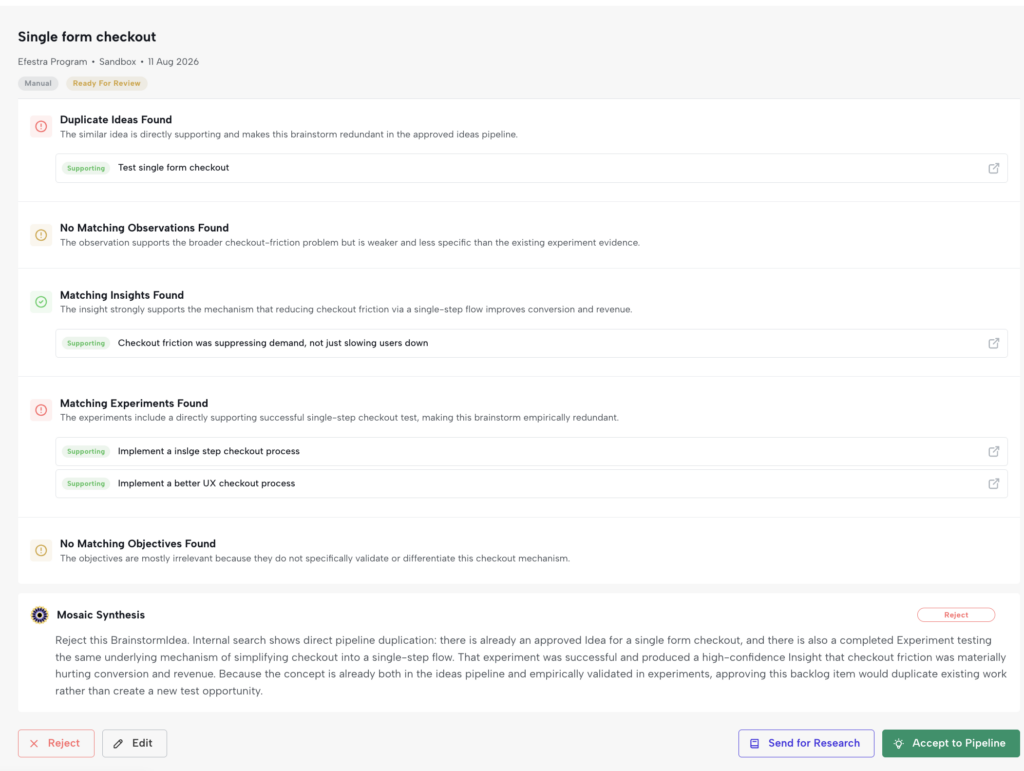
When an idea enters Brainstorm, it does not sit in a queue waiting for someone to find time. It arrives surrounded by context: the evidence that supports or contradicts it, the objectives it maps to, and whether something like it has been tested before and what happened when it was.
That context is drawn from your organisation’s own material. Prior test results. Research repositories. Analytics. The things you have already paid to produce and mostly cannot find.
Brainstorm comes at two depths.
In Launchpad, it grounds ideas in your own data, so a team new to structured experimentation stops generating hypotheses from instinct and starts generating them from what they already know.
In Flywheel, it adds business objective alignment and your wider evidence base, so an established programme can see collisions, duplicates and misalignment before a test slot is committed rather than after.
Ideas from real meetings
Most good ideas are spoken aloud in meetings and then lost, because capturing them properly means someone leaving the conversation to write things down.
With the Mosaic Companion connector, an idea raised in a meeting arrives in Brainstorm on its own. No form, no handoff, no note-taker. The chain runs from the moment someone says something worth testing, through synthesis, to a decision that is recorded.
The decision stays with a person
This is the part we will not compromise on, so we will state it plainly.
Mosaic supplies context. It does not rank ideas, score them, approve them or reject them. A person reads what has been assembled and decides: proceed, park or kill. That decision is recorded, with a reason and a name attached.
The output of Brainstorm is not a sorted list. It is a defensible decision. Six months from now, when somebody senior asks why their idea never ran, the answer is not a recollection. It is a record.
What Brainstorm is not
It is not AI prioritisation. Software that ranks your roadmap moves accountability from a person to a model. When the ranking is wrong, nobody in the building is answerable for it.
It is not a pattern library. External idea databases solve a shortage of ideas. No team we have worked with has a shortage of ideas. They have a surplus nobody can sort, and a pattern that won on somebody else’s users, traffic and price point is a hypothesis about your business rather than evidence about it.
It is not a required field. Documentation is not governance. A field that accepts any text records that someone typed something. It does not record that anyone thought.
Available now
Brainstorm is live in both Launchpad and Flywheel, with the Companion connector available to all licence holders.