
Every experimentation programme has the same quiet problem. The best ideas for what to test next do not appear when someone opens a planning tool and stares at a blank hypothesis field. They appear in the middle of a product review when someone says “we should test that.” They appear in sprint planning when a designer challenges an assumption. They appear in customer call debriefs when the support lead describes a pattern no one else has noticed.
And then they disappear.
Not because anyone decides to ignore them. Because there is no system designed to catch them. The idea lives in someone’s memory, or in a one-line note in a meeting summary, or in a Slack message that will be buried by tomorrow afternoon. By the time the team sits down to plan next quarter’s experiments, most of these ideas are gone. The ones that survive tend to be the loudest, not the best.
This is the gap Mosaic Companion was built to close.
What Companion Does
Mosaic Companion is an AI meeting assistant built specifically for experimentation and product teams. It joins your video calls, listens to the conversation, and identifies moments where experiment ideas surface. Not just “someone mentioned testing.” Companion recognises when a hypothesis is being formed, when an assumption is being challenged, when a data point triggers a question worth investigating.
After the meeting, Companion produces a structured export of every experiment idea discussed. Each idea is captured with the context that surrounded it: what problem it was responding to, what evidence or observation prompted it, which business objective it connects to, and who raised it. This is not a transcript summary with action items bolted on. It is a purpose-built output designed for teams that need to turn conversation into structured experiment plans.
The ideas arrive ready to review, ready to prioritise, and ready to develop into proper test plans. No more translating sticky notes. No more reconstructing conversations from memory. No more losing the reasoning behind an idea because the only thing that got written down was a four-word title.
Why This Matters More Than It Sounds
The obvious value of Companion is time saved. Someone does not have to take notes during the meeting. Ideas do not need to be manually transcribed into a tracker afterwards. That is real, and it matters.
But the deeper value is structural. Most experimentation teams suffer from what we call the Evidence Gap: a disconnect between the evidence an organisation generates and the decisions that evidence should inform. Ideas are a form of evidence. When a senior product manager hears a customer insight and immediately connects it to a testable hypothesis, that connection is valuable. It reflects experience, context, and pattern recognition that a planning tool cannot replicate.
When that connection is lost because nobody wrote it down properly, the team does not just lose an idea. They lose the link between the evidence and the potential decision. The next time someone proposes a similar experiment, they will have to rebuild the reasoning from scratch, if they even remember the original observation.
Companion preserves the link. The idea and its context travel together from the meeting into whatever planning process follows.
How It Works
Companion joins your video meetings on Google Meet, Zoom, or Microsoft Teams. You invite it the same way you would invite a colleague. It records the conversation and uses AI to identify experiment-relevant moments.
During the meeting, it streams ideas discussed in real time to the Mosaic app.
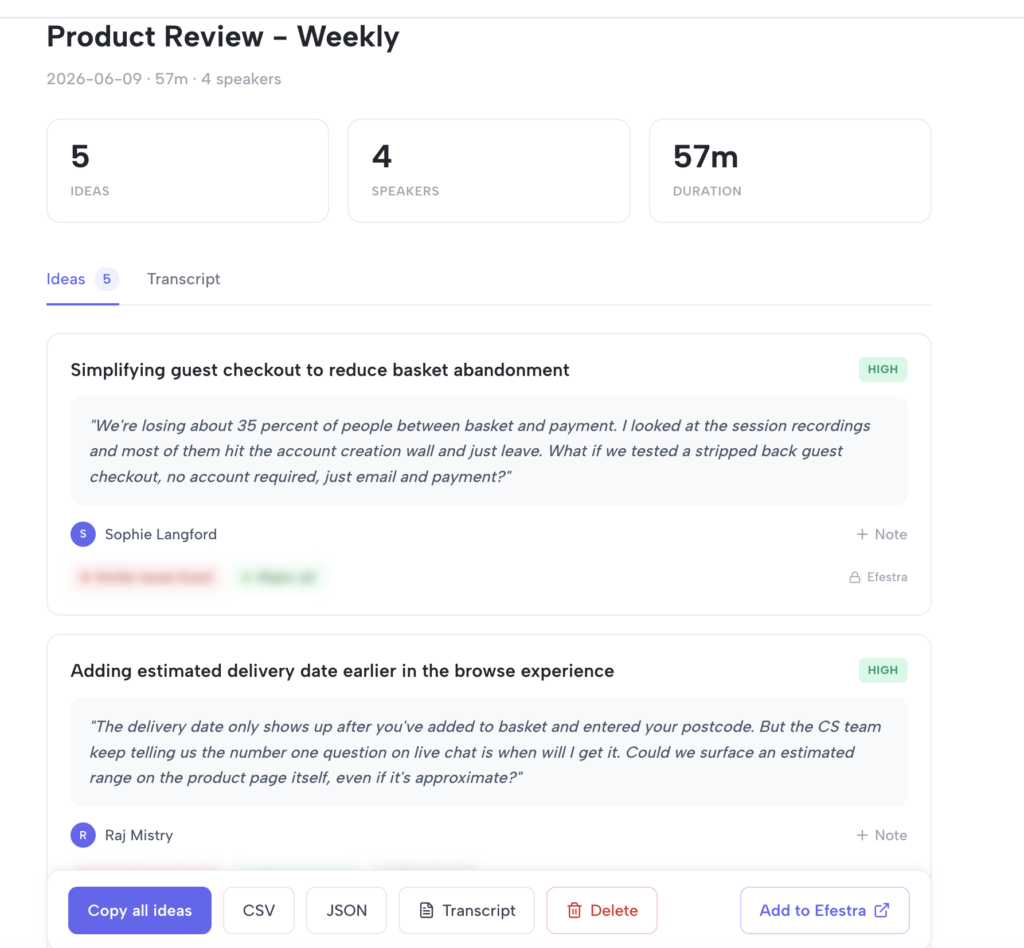
After the meeting, you receive a summary that separates experiment ideas from general discussion. Each idea is structured with enough detail that a product manager can evaluate it without having attended the meeting or listened to the recording. The output is exportable and designed to feed into your existing planning workflow, whether that is Efestra Launchpad, a spreadsheet, Jira, or a shared document.
The AI behind Companion is Mosaic, the same intelligence layer that powers all Efestra Products across the suite.
What It Is Not
Companion is not a general-purpose meeting transcription tool. There are plenty of those. It does not try to summarise everything discussed, generate action items for every participant, or replace your existing meeting notes process.
It is built for one purpose: ensuring that experiment ideas which emerge naturally in team conversations are captured, structured, and made available to the people who decide what to test next. Everything about the product, from the AI prompts to the output format, is optimised for this specific use case.
Companion is also not an automation engine. It does not decide what to test. It does not launch experiments. It does not remove human judgement from the process. It captures the raw material of experimentation, the ideas and their context, so that human judgement has better material to work with.
Pricing
Companion has a free tier that covers the core functionality as well as free use for synthesis from transcripts uploads. For teams that want expanded capacity, Pro is available at £8.99 per month.
For organisations using Efestra Flywheel, Companion is included in the licence.
Three Ways to Use Companion
Companion is a standalone product. You do not need any other Efestra product to use it, and many teams will not. But the value scales depending on what sits downstream of the ideas it captures.
On its own, Companion captures experiment ideas from your meetings and produces a structured export. Each idea arrives with its context: the problem it was responding to, the evidence behind it, who raised it. You export that into whatever system your team already uses, whether that is Jira, Notion, a spreadsheet, or a shared document. The ideas are structured and ready to work with. For teams that currently rely on someone taking notes or a general-purpose transcription tool, this alone changes how many good ideas survive the gap between conversation and action.
With Efestra Launchpad, the ideas go further. Instead of landing in a document for someone to process later, they feed directly into Mosaic Guide, the AI experiment planner at the centre of Launchpad. A rough idea spoken in a Thursday morning product review arrives in Mosaic Guide already partially structured. The product manager reviews it, Mosaic Guide shapes it into a proper experiment plan (recommending a hypothesis, suggesting metrics, flagging similar past experiments), and within minutes the idea has become a structured, prioritised test plan ready to build. For product managers and experimentation leads, this is the real unlock: the distance between “we should test that” and a plan someone can act on shrinks from weeks to minutes. No re-typing, no context loss, no manual translation from meeting note to hypothesis.
With Efestra Flywheel, Companion becomes part of the governance infrastructure. Ideas captured from meetings inherit the full governance layer: collision detection against running experiments, automatic connection to business objectives, tagging against the team’s taxonomy, and visibility on the executive dashboard. When a head of product asks “where are our experiment ideas coming from?”, the answer includes not just what was formally submitted through the planning process but what emerged organically in team conversations. The learning loop starts earlier. Nothing falls through the gap between discussion and decision.
Standalone Companion is a capture tool. With Launchpad, it becomes an idea-to-plan pipeline. With Flywheel, it becomes part of the system that turns evidence into decisions across the organisation.
The Bigger Picture
Companion is part of a broader pattern in how Efestra thinks about experimentation, research and evidence infrastructure. The industry has invested heavily in tools that help teams execute experiments: feature flags, statistical engines, testing platforms. What has been underbuilt is the infrastructure around experiments: the systems that ensure the right experiments get proposed, that evidence informs the decision about what to test, and that learnings from past experiments reach the people who need them.
Companion sits at the very beginning of that chain. Before the hypothesis is written. Before the backlog is prioritised. At the moment when someone in a room says “we should test that” and, for the first time, the system is actually listening.
Mosaic Companion is available now. Start now with the free tier
Mosaic Companion is part of the Efestra decision intelligence suite.