A year ago, we changed our name from Effective Experiments to Efestra. At the time, I wrote that it was not just a name change. It was the beginning of a fundamental rethink of what we were building, who we were building it for, and how we believed experimentation governance should work.
Today, that rethink is complete. This post is about what changed, what we held onto, and what Efestra looks like now.
The problem we kept seeing
The same pattern appears in almost every organisation we work with. They invest in experimentation. They run tests. They commission research. They generate evidence. And then that evidence sits in slide decks, Confluence pages, Airtable boards and Slack threads that nobody reopens.
We call this the Evidence Gap: the structural disconnect between the evidence organisations generate and the strategic decisions that evidence should inform.
It is not a people problem. It is not a skills problem. It is an infrastructure problem. The tools exist to run experiments. The tools exist to collect data. But the layer that connects all of that to how organisations actually make decisions? That layer is missing in most companies. And in its absence, teams fill the gaps with general-purpose tools, stitched together manually by someone who holds the whole thing together through memory and effort. We call that the frankenstack. It sort of works until that person leaves, the team grows, or leadership asks a question that requires connecting evidence across tools and time.
What we got wrong
For years, we told organisations that if they wanted proper governance, they had to use our system. Move your workflows. Adopt our platform. Do it properly or do not do it at all.
I still believe that dedicated governance infrastructure produces the best outcomes. That has not changed. The conviction that evidence integrity, evidence synthesis and decision influence require purpose-built systems rather than bolted-on features is still at the core of everything we build.
What has changed is the all or nothing approach.
The reality is that many organisations are not ready for a full platform shift. Some are not there yet. Some will never be. But they still suffer without governance. Experiments run without methodology. Results go unrecorded. Decisions happen without reference to the evidence that was generated to inform them.
And we realised that our insistence on the full platform was stopping these organisations from getting the governance they needed. We were, inadvertently, the reason some teams went without it.
So we stopped making it all or nothing.
Four products, four starting points
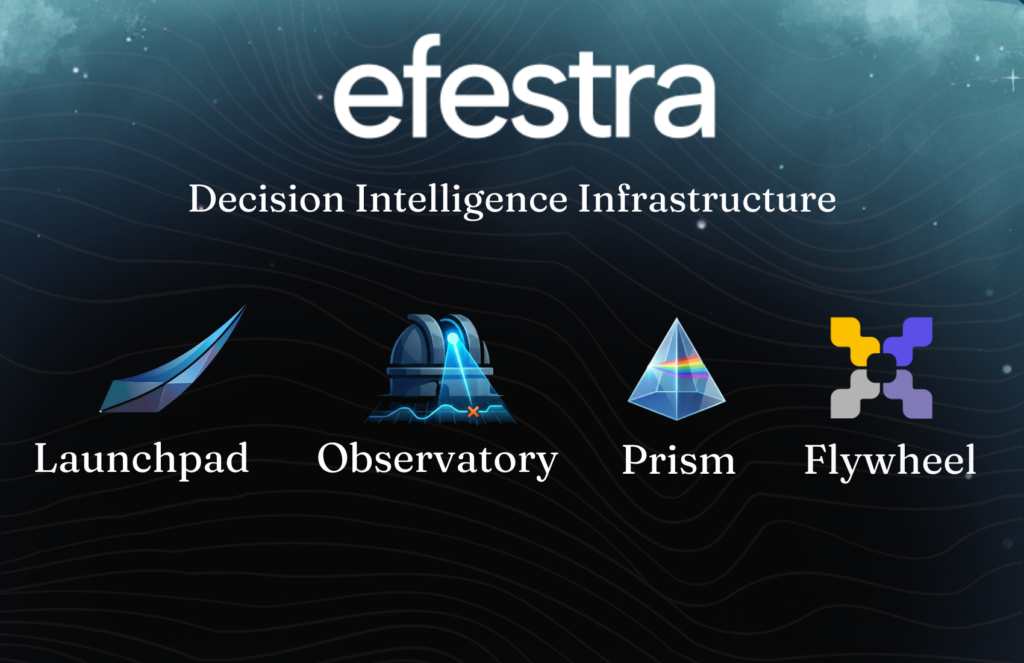
Efestra is no longer a single platform. It is four products, each solving a different piece of the Evidence Gap.
Observatory
This is the product we resisted building for the longest time. Observatory provides governance for the tools organisations already use. Connect your Airtable, Jira, ClickUp or Asana, and Observatory places a governance layer on top without changing a single workflow.
No migration. No ripping out what works. Just visibility into whether experiments are designed properly, whether results are being recorded, whether decisions are being made, and whether the programme is actually delivering what it claims.
Observatory is for product leaders and experimentation managers who want oversight and accountability without the shift in tools. Because companies without Efestra still struggle without governance, and we should not be the reason they go without it.
Observatory also serves as the diagnostic entry point across the full Decision Intelligence Stack. It assesses evidence trustworthiness, cross-team discoverability, and whether evidence is reaching the people making strategic decisions. The output is a report that quantifies the gaps. That report often becomes the internal business case for deeper investment.
Launchpad
Launchpad is for teams starting from near zero. The company knows it should be testing but has no methodology, no structure, and no governance to build on.
At its core is Mosaic Guide, an AI-powered experiment planner. A product manager types a rough idea in plain language. Mosaic Guide analyses it and returns a structured experiment plan: a readiness score, feedback on gaps, a properly formatted hypothesis, suggested metrics, and checks against the team’s existing experiments for collisions and duplicates.
The PM reviews, adjusts and decides. Governance is built in invisibly. There are no mandatory fields, no approval gates, no friction. Just structure that makes good practice the path of least resistance.
Launchpad is designed so that the natural next step, when a team outgrows it, is Flywheel. But it stands alone as a product for teams that need a foundation before they need enforcement.
Prism
Prism is a research governance platform. It exists because of a problem that sits adjacent to experimentation but is rarely addressed by the same tools: research that never reaches the people making decisions.
Research teams commission studies, run surveys, conduct user interviews and produce findings that are genuinely valuable. But those findings decay. They sit in repositories that nobody searches. They get summarised in presentations that are read once and filed. Six months later, the same questions get asked again, the same studies get commissioned, and the cycle repeats.
Prism connects research to decisions. Every study is linked to a business objective and a decision owner. AI synthesis (powered by Mosaic) drafts cross-study analysis in minutes instead of days. Researchers verify accuracy and add nuance before anything reaches a decision maker. And when research influences a decision, that impact is tracked and visible.
For heads of research and research ops teams, Prism answers the question that keeps coming up: how do you prove the ROI of research?
Flywheel
Flywheel is the full decision intelligence platform. Governance enforcement, executive dashboards, institutional memory, audit trails, decision protocols and governance scoring.
This is where we believe the greatest value lives. It is the product for organisations ready to make evidence work at scale, across teams, across time, with accountability at every stage.
Flywheel is where guidance becomes enforcement. Where the boundary shifts from “this is what good looks like” to “this is how we operate.” Quality gates, approval workflows, collision detection, and executive reporting that shows decision influence rather than activity metrics.
It is no longer the only door in. But it remains the destination.
Where AI fits, and where it does not
Every Efestra product is powered by Mosaic, our AI layer. And because the question will come up, here is our position on AI in experimentation.
The dominant narrative in the industry right now is automation. Let AI build up a list of ideas and generate hypotheses. Let AI analyse results. Let AI decide what to test next. Remove the human from the loop because humans are slow and AI is fast.
We think that narrative is dangerous.
AI that removes human judgement from experimentation does not make organisations smarter. It makes them faster at being wrong. It amplifies noise, not signal. If the methodology is unsound, AI will scale unsound methodology. If the evidence is unreliable, AI will synthesise unreliable evidence and present it with confidence. Speed without integrity is not progress.
Mosaic takes a different approach. It shapes thinking. It does not replace it.
In Launchpad, Mosaic Guide takes a rough idea and structures it into a proper experiment plan. It identifies gaps, suggests improvements, checks for collisions. But the product manager reviews everything, makes the final call, and owns the decision. The AI makes good practice easier. It does not make human judgement optional.
In Prism, Mosaic synthesises research findings across studies in minutes rather than days. But a researcher verifies accuracy, adds context, and certifies the synthesis before it reaches anyone making a decision. The AI handles the volume. The human ensures the quality.
This is a deliberate line that runs through everything we build. AI as a thinking partner, not a replacement for thinking. The moment you remove the human from the loop, you have not automated experimentation. You have automated the appearance of rigour while removing the substance of it.
The architecture underneath
All four products sit within what we call the Decision Intelligence Stack, a three-layer framework that underpins everything.
Layer 1 is Evidence Integrity. Can you trust what you have generated? Are experiments designed properly, free from collisions, methodologically sound? Are results interpreted correctly? Without this layer, every decision built on top is compromised.
Layer 2 is Evidence Synthesis. Can you connect what you know across teams, studies and time? This is the layer almost nobody in the industry addresses. Evidence decays. Studies get repeated. Insights sit in silos. Synthesis is what turns isolated data points into cumulative organisational knowledge.
Layer 3 is Decision Influence. Does trustworthy, synthesised evidence actually reach the decisions that matter? Are decision protocols defined before experiments launch? Is evidence visible to the people who need it? Is there accountability for acting on it?
Governance runs through all three layers as connective tissue, not as a separate concern. At Layer 1, governance is quality assurance. At Layer 2, governance is knowledge standards. At Layer 3, governance is decision accountability. When governance works, it is invisible. Teams do not feel governed. They feel supported.
Observatory diagnoses gaps across all three layers. Launchpad addresses Layer 1 for early-stage teams. Prism addresses Layer 2. Flywheel governs the full stack.
What this means in practice
A year ago, there was one product and one conversation: are you ready for the full platform? If the answer was no, there was nothing else to offer.
Now there are four starting points.
If you are running experiments in existing tools and want governance without migration, Observatory is where you start. If you are building an experimentation function from near zero and need methodology and structure, Launchpad is where you start. If your research team produces brilliant work that never reaches decision makers, Prism is where you start. If you need evidence and decisions to work together across the organisation, Flywheel is where you start.
Each product stands alone. Each leads naturally to the next if and when the organisation is ready. The path is not forced. The value comes first.
The rebrand a year ago was the signal. This is the substance behind it.